
How to Choose the Right Curtain Heading?

Updated: Jul 13
There is of course the matter of personal preference when it comes to choosing the right curtain heading for you, but every heading has its pros and cons as well as best uses. Let's take a closer look at today's top headings:
For more information about Zenterior's bespoke curtains made in Cornwall, click here.
Wave

Wave curtains, invented by our trade partners Silent Gliss, have taken the interiors market by storm, and it is easy to see why. This heading creates a smart, effortlessly elegant style and really shows off patterned fabric beautifully as there is no pleating to distort the intended design.
There are some beautiful feature tracks available for Wave, but equally there are some tiny discreet tracks that fit directly to the ceiling or inside the recess giving the effect of floor to ceiling curtains.
PROS
1) The best curtain heading for stack back. This is because this style of pleats concertinas the fabric back, and there is no excess gather used in Wave curtains at all. This means that when the curtains are drawn back they take up less space than any other curtain heading.
2) Wave tracks can be face fixed or top fixed (to the wall or to the ceiling)
3) Does not distort patterned fabric.
4) Sleek and modern design.
5) Extremely economical with fabric, especially when using room high material.
6) Good blackout effect when fitted floor to ceiling.
CONS
1) You have to use a Wave track for Wave curtains. This in itself is only a negative if you already have a track or pole in mind, or if you were not wanting to spend very much on the track as they are more expensive than non Wave options.
2) They can look odd as short curtains. Wave is very much intended to be taken to the floor and I never feel they look right if your curtains need to be shorter.
Pencil Pleat

Pencil Pleat is still by far the most popular curtain heading. As the name suggests, this heading when pulled up is designed to look like a row of pencils standing on their ends.
This heading comes in a number of different depths, the most popular being 3" or 6" for longer length curtains (over 200cm).
PROS
1) Along with cottage pleat, this is the most economical curtain heading for labour charges as it is the least time consuming to make.
2) This heading really suits cottages and smaller spaces, and when hung correctly gathers beautifully.
3) Looks good short length, full length or pooling on the floor, so if you have uneven floors to work with these curtains will pull it off.
4) Can be made at an angle to fit apex windows.
5) Can be fitted on a pole or track, top or face fixed (to the wall or to the ceiling)
6) Good blackout effect when fitted floor to ceiling or close to the wall on a track.
CONS
1) Worst curtain heading for stack back as the fabric is ruched against itself. This means that when the curtains is drawn back it will take up more space than other headings.
2) Of all curtain headings, this is the one that most benefits from professional fitting because when it is first hung, it needs to be dressed into pleats to allow the fabric to learn the correct way to hang.
Cottage Pleat
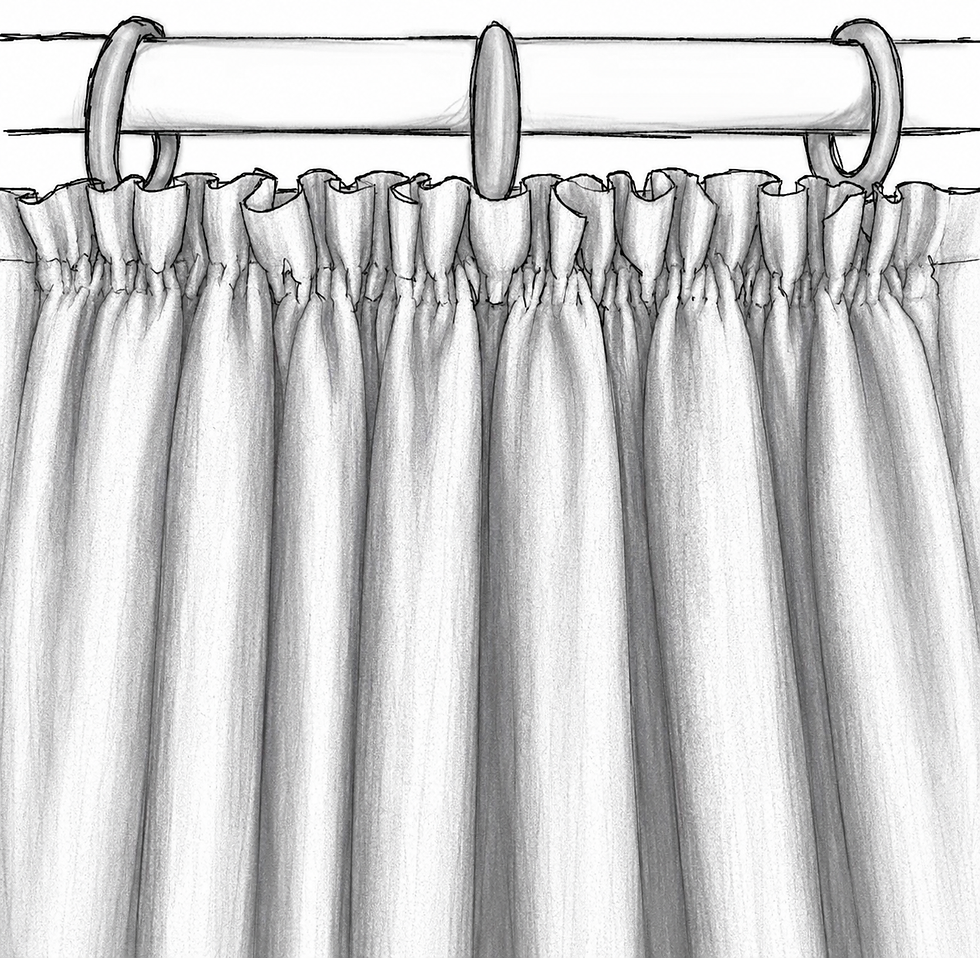
Cottage pleat is a more casual, relaxed pleat that has hugely gained in popularity over the past decade. Similar to pencil pleat, it is made using heading tape on the back of the curtain that pulls up to create the ruffle, but the tape is set down to allow the soft ruffle effect to form above the tape.
Usually made with a 1" or 2" tape, it can also use 3" or 5" ruffle tape to give different proportions to the structured section.
PROS
1) Along with pencil pleat, this is the most economical curtain heading for labour charges as it is the least time consuming to make.
2) This heading really suits cottages, casual and smaller spaces, and when hung correctly gathers beautifully.
3) Looks good short length, full length or pooling on the floor, so if you have uneven floors to work with these curtains will pull it off.
4) This heading works beautifully for café voile curtains, giving that classic French, shabby appeal.
5) Can be fitted on a pole or track, face fixed to the wall.
6) Good blackout effect when fitted floor to ceiling or close to the wall on a track.
CONS
1) Worst curtain heading for stack back as the fabric is ruched against itself. This means that when the curtains is drawn back it will take up more space than other headings.
2) The smaller, softer heading can allow the curtains to sag slightly between curtain hooks, especially for heavier weight curtains, so not ideal if your aiming to have a curtain that sits perfectly level off the floor.
3) Cannot be fitted to a ceiling fixed track as the top of the pleats would brush on the ceiling.
Pinch Pleat
Pinch Pleat is a hand made heading that is made to fit the width of your pole by creating bunches of pleats with gaps between them across the width of your curtains.
The Triple Pinch Pleat is the most commonly used, and is traditionally what is meant by the term "Pinch Pleat", however the heading is also available as a Double Pinch or even Single Pinch. This can come in very handy if you need to cut down on cost as the less pleats you have in your heading, the less gather is required which can mean saving on both fabric and labour charges.
This heading can also be made with buttons on the pinched part of the pleat. This can come in very handy if you are trying to find a fun way to bring out your accent colour.
PROS
1) This is a very smart heading where the pinches hold the curtains in their pleats making them a very easy heading to dress as they like to hang in uniform pleats.
2) Pinch Pleats are just so elegant and opulent in a room. If you want to have a curtain heading that is going to get noticed, this is the one.
3) Good stack back. Despite being fabric hungry, because the gather is used up by the concertina action of the pleats these curtains do not take up a great deal of space when pulled back. They also look really good when open, making them excellent dress curtains.
CONS
1) This is the priciest curtain heading as Pinch Pleats require more gather than other headings which can mean more fabric and more widths of labour charges. They also have the highest labour charge as they are the most time consuming to make.
2) Pinch Pleats require space behind them so that the fabric between the pleats can fold back. This means the need to be hung from a pole with good clearance from the wall, or from a top fixed track that is projecting far enough into the room to give them space.
3) Because of the shape the pleats pull the fabric into, any pattern on your fabric will be distorted at the top of the curtain. This is not usually an issue with most patterns, but be aware particularly with vertical stripes as the pattern is intended to run straight up and down.
Euro Pleat

Euro Pleat is a hand made heading where a stiffener is added to the top of the curtain so each pleat can be created uniformly across the curtain.
This heading is calculated precisely to the width of you pole so as you pull them across the pleats sit perfectly in a pleat - flat - pleat - flat formation across your window.
This is essentially a more modern version of the pinch pleat, with the same making method inverted.
PROS
1) This is such a sleek, modern and opulent curtain heading. Less common that other curtain headings, it's bound to get noticed for it's uniqueness.
2) This elegant heading is well suited to sleek contemporary settings, but also works well in high ceilinged period properties when paired with a traditional pole.
3) Excellent stack back and uniform pleats.
CONS
1) As a hand made pleat, the time consuming nature of the making means the labour charges for Euro Pleat are more than headings made with a tape.
2) Euro Pleats require space behind them so that the fabric between the pleats can fold back. This means the need to be hung from a pole with good clearance from the wall, or from a top fixed track that is projecting far enough into the room to give them space.
3) Because of the shape the pleats pull the fabric into, any pattern on your fabric will be distorted at the top of the curtain. This is not usually an issue with most patterns, but be aware particularly with vertical stripes as the pattern is intended to run straight up and down.
Eyelets

Zenterior's Eyelet Curtains are hand sewn with metal eyelets stamped in by machine to ensure a tight fit.
The eyelets themselves are available in a range of sizes and colours so they can be matched to your pole.
PROS
1) Eyelets are a great heading for showing off a pattern as they do not distort the material at all.
2) A good heading if you have a nautical theme as the eyelets themselves mimic portholes or eyelets used for sails.
3) No curtain rings are required as the curtains run directly across the pole.
CONS
1) Not ideal for blackout as there is light bleed through the eyelets themselves.
2) Should not be used with embroidered fabric as the embroidery can fray around the eyelets.
3) Can only be hung from a pole.
4) Not suitable for bay windows as the eyelets cannot move past the brackets.
5) Not suitable for single curtains if the pole required is longer than 180cm as a centre bracket would be required.
6) Eyelets are more likely to scratch poles over time than curtain rings.
Top Tip
Top tip for any curtains... If they are not running smoothly, use silicone spray on your pole or track. #TradeSecretsRevealed


Comments